

Catherine Henderson,
Legal Means/CBS Supervisor
“It brought everything together and really made me focus on everything I had learned. The immediate thing that jumped out was me! That I am the centre of my life, the constant in my life and that everything stems from that – my decisions, my goals, my choices, who I interact with and how I act with them.”
What happens when you pause long enough to think deeply about who you are, what grounds you, and how you lead? For Catherine, this reflection became the foundation of something powerful: a personal leadership compass she named ‘Catherine’s Universe’.
This wasn’t a pre-planned framework pulled from a textbook. It emerged through curiosity, reflection, and the influence of leadership development experiences—particularly her engagement in the LAA Personal Leadership Programme. What began as a metaphor became a visual map and, ultimately, a mindset.
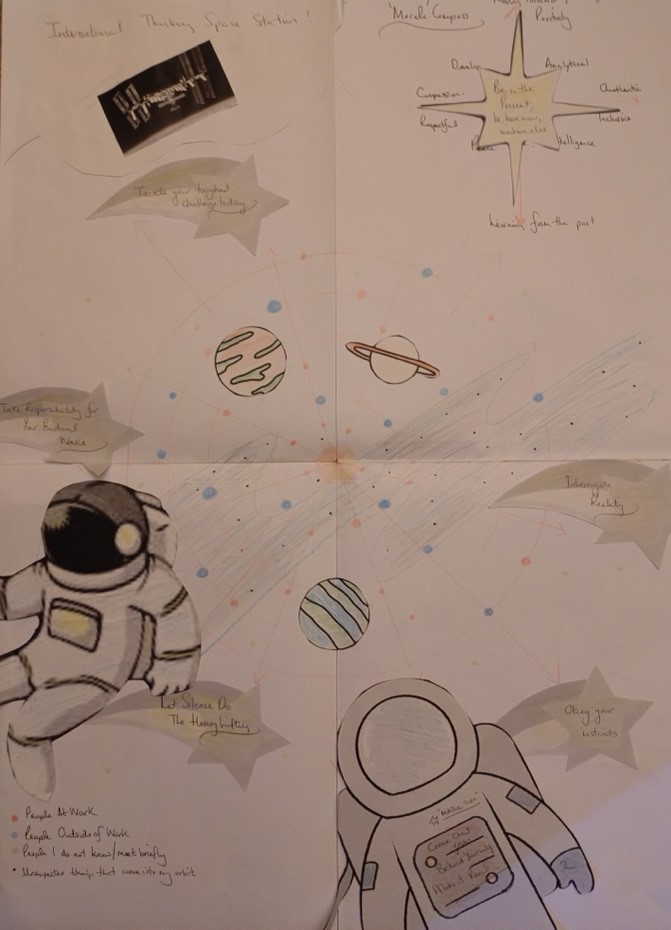
Catherine began with one clear idea: “The sun rises every day, whether it’s good or bad. From this, she formed a central belief: “I am the sun. I am at the centre of my universe. I am here, I am present, I am ready for the new day, every day.”
This became the starting point for her leadership compass. Rather than looking outward for stability, she grounded herself. “Who keeps me grounded? Me.” With this, she articulated a core leadership truth: self-leadership is the anchor for everything else.
From here, she mapped out the people in her life as planets, orbiting her sun at varying distances:
- Pink planets represent colleagues and connections at work.
- Blue planets reflect relationships outside of work, family, friends, personal networks.
- Green planets stand for fleeting or invisible interactions, those who may never meet her, but who are still touched by her actions, tone, or influence.
This way of thinking invited a compassionate and flexible view of human connection—understanding that orbits change, and closeness varies. It gave her a way to view relationships not as fixed roles, but as dynamic and fluid.
One of the most profound elements Catherine added to her universe was the asteroid belt. It became a symbol of the unexpected, the crises, setbacks, and difficult conversations that can throw us off course. But instead of fearing these, Catherine chose to acknowledge them as part of the system: “We just need to manage these risks/problems as they arise. Take on your toughest challenge today.”
Hovering above the system is the International Thinking Space Station—a concept she brought to life through the principles of creating thinking spaces. It represents the importance of slowing down to reflect, avoid knee-jerk reactions, and gain perspective. From here, leaders can see the whole system, not just their immediate challenges.
She also integrated a ‘Morale Compass’—her internal guide for values-based leadership. It points forward, not backward. Catherine chose to carry her beliefs, learn from the past, and keep moving, welcoming those who choose to join her journey, without dragging the weight of what can’t be changed. It also acts as a confidence boost when she feels challenged and doubts her ability, drawing on past experiences and using it for her morale when needed.
And finally, she brought in a touch of humour and realism: “In space, no one can hear you scream.”
A reminder to embrace silence, stay calm under pressure, and let presence and pause speak louder than noise.
Through this creative process, Catherine didn’t just build a personal leadership model, she sparked a way of thinking that others can learn from too. Her universe is a reminder that leadership is deeply personal, profoundly relational, and beautifully adaptable. It shows us how to remain centred, how to map the people and challenges around us, and how to keep moving, thoughtfully, purposefully, and with humour.
Catherine’s Leadership Compass offers a model for calm, conscious leadership, rooted not in control, but in clarity.